
IoT-Driven Fleet Management for Modern Enterprises
Explore how IoT-driven fleet management transforms operations, cuts costs, and enables data-driven innovation for modern enterprises.

Quick Answer
IoT-driven fleet management connects vehicles, sensors, and cloud platforms to give enterprises real-time visibility into asset location, driver behavior, maintenance needs, and fuel use. This enables lower operating costs, higher safety, better compliance, and more reliable delivery performance. Successful initiatives start with clear business outcomes, careful device and connectivity choices, and robust integration with ERP, TMS, and analytics. Leaders must address data governance, cybersecurity, and change management, then layer AI for route optimization, predictive maintenance, and dynamic pricing. The article also outlines how VarenyaZ can help design and build IoT, web, and AI solutions.
In this article
Coverage signals
14 min
May 22, 2026
VarenyaZ Editorial Desk, Technical Content Review
Updated May 22, 2026
Key Takeaways
- IoT-driven fleet management connects vehicles, sensors, and cloud systems to turn logistics operations into a real-time, data-rich platform.
- The biggest wins come from cost reduction, safety improvements, compliance automation, and better customer experience—not just GPS tracking.
- Architecture choices around devices, networks, and cloud platforms determine long-term scalability, security, and AI readiness.
- Integrating fleet data with ERP, TMS, CRM, and data warehouses creates a single source of truth for operations and finance teams.
- Data governance and cybersecurity must be designed in from day one to meet standards like ISO 27001 and NIST guidance.
- AI amplifies IoT value through predictive maintenance, route optimization, and dynamic dispatch decisions.
- Change management and user-centred design are essential to secure driver and dispatcher adoption, not just executive sponsorship.
- Specialist partners like VarenyaZ can accelerate implementation with custom web portals, telematics integrations, and AI analytics solutions.
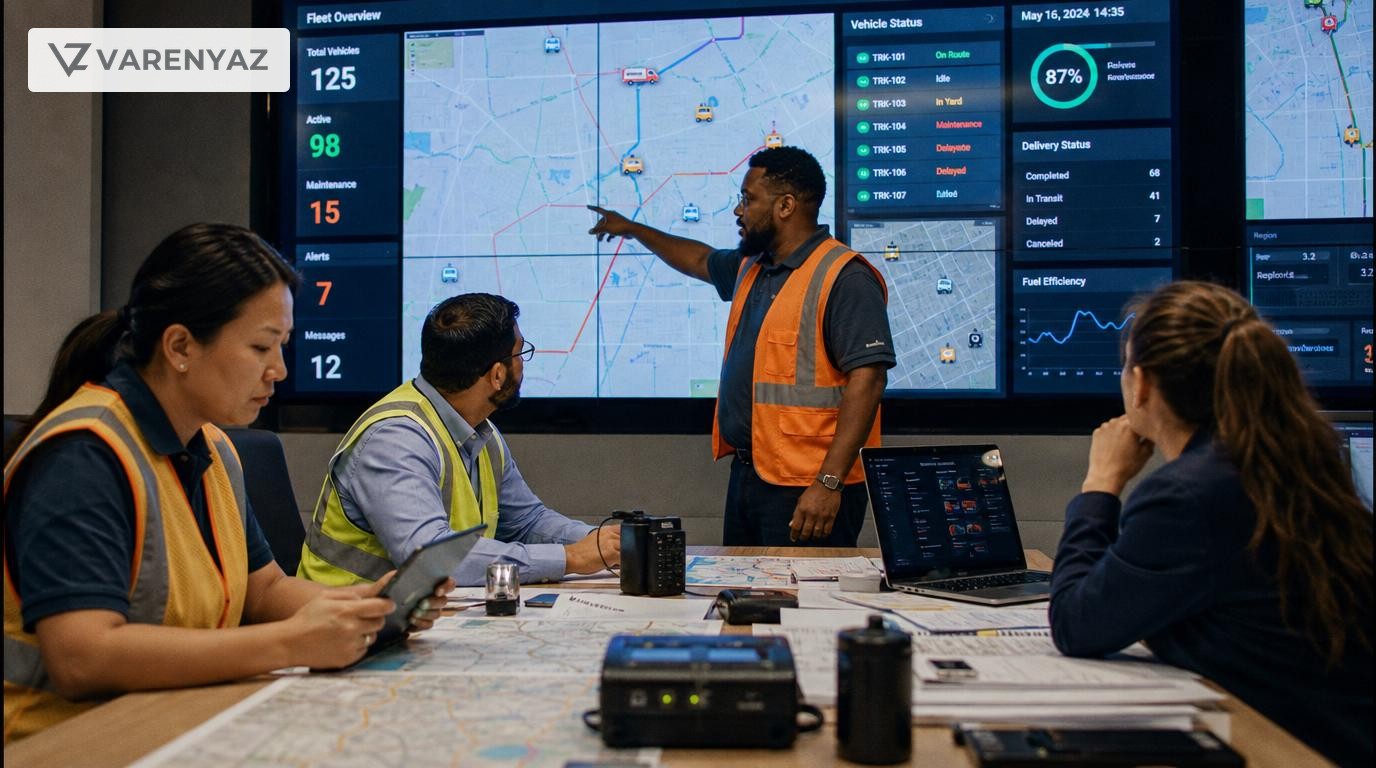
The role of IoT-driven fleet management in advancing enterprise technology
For many enterprises, the fleet is no longer just a cost center or a line item in operations. It is a live, moving network of data. With IoT-driven fleet management, every vehicle, trailer, container, and driver becomes a sensor that feeds real-time intelligence into your wider technology stack.
This shift is quietly transforming how logistics, field services, retail, manufacturing, and even healthcare organizations plan, execute, and optimize their operations. It is also reshaping the expectations of customers who now assume accurate ETAs, transparent tracking links, and proactive communication as standard.
In this article, we break down how IoT-driven fleet management works, the business value it unlocks, the architecture and implementation choices you will face, and the risks and tradeoffs to manage along the way. We will also explore how this transformation ties into broader digital and AI strategy—and where a partner like VarenyaZ can help you move faster and smarter.
Direct answer: what is IoT-driven fleet management and why does it matter?
IoT-driven fleet management is the use of connected sensors, telematics devices, and cloud platforms to monitor and optimize vehicles and mobile assets in real time. It combines GPS, on-board diagnostics (OBD), environmental sensors, and driver behavior data with analytics, automation, and AI.
For enterprises, this matters because it turns the fleet into a live information system. Instead of relying on manual logs, phone calls, and after-the-fact reports, operations teams gain real-time visibility into where assets are, how they are being used, what condition they are in, and how safely they are being operated. That visibility unlocks lower costs, better customer experience, stronger compliance, and a powerful data foundation for future AI initiatives.
How IoT-driven fleet management works
From vehicles to the cloud: the data flow
At a high level, IoT fleet systems follow a simple but powerful pattern:
- Sense – Devices in vehicles and assets capture data: GPS location, speed, engine diagnostics, fuel level, load status, temperature, door open/close, driver behavior events, and more.
- Transmit – Data is sent over cellular, satellite, or Wi-Fi networks to a gateway or directly to the cloud.
- Ingest – Cloud platforms ingest and normalize this data, often using message brokers and time-series databases.
- Analyze – Analytics and AI models detect patterns, anomalies, and optimization opportunities.
- Act – Dashboards, alerts, and integrated workflows trigger actions: route changes, maintenance tickets, customer notifications, compliance reports, and performance coaching.
This loop runs continuously, creating a “digital twin” of your fleet in motion.
Key components of an IoT fleet management stack
While every implementation varies, most enterprise architectures include these layers:
- Edge devices and sensors
- OBD-II or CAN-bus telematics units reading engine and vehicle data.
- GPS modules for location, speed, and geofencing.
- Environmental sensors (temperature, humidity, shock) for cold chain and high-value goods.
- Door and cargo sensors to track loading, unloading, and security.
- Driver terminals or mobile apps for tasks, navigation, and communication.
- Connectivity
- 4G/5G cellular networks for high-bandwidth, low-latency data transfer.
- Low-power networks (e.g., LPWAN) for specific sensor types with modest data needs.
- Satellite connectivity for remote routes with poor cellular coverage.
- IoT and telematics platform
- Device management and provisioning.
- Data ingestion, normalization, and enrichment (e.g., mapping raw coordinates to street addresses).
- Rules engine for events and alerts (e.g., speeding, idling, geofence breaches).
- APIs and webhooks for integration with enterprise systems.
- Data and analytics layer
- Time-series and analytical data stores for historical analysis.
- Business intelligence dashboards and self-service reporting.
- Machine learning pipelines for predictive maintenance, routing, and risk scoring.
- Applications and user interfaces
- Fleet control tower dashboards.
- Mobile apps for drivers and field technicians.
- Customer-facing tracking portals and notifications.
- Back-office tools for finance, compliance, and customer service teams.
Each of these layers has implications for cost, scalability, security, and how quickly you can evolve towards AI-led operations.
The business value of IoT-driven fleet management
1. Operational efficiency and cost reduction
For many organizations, the first wave of value is straightforward: more efficient use of vehicles, drivers, and fuel.
- Fuel optimization – GPS and engine data reveal harsh acceleration, speeding, excessive idling, and suboptimal routing, all of which drive fuel costs up. Coaching and route optimization often deliver measurable fuel savings.
- Asset utilization – Real-time location and status data show which vehicles or trailers are underused. This often reduces the need to acquire additional assets and helps rebalance capacity across regions or depots.
- Maintenance planning – Instead of running vehicles to failure or sticking to rigid time-based schedules, maintenance teams can use mileage, engine hours, and diagnostic trouble codes to schedule interventions when they are needed, reducing both breakdowns and unnecessary shop visits.
These benefits are not speculative; they show up quickly in reduced fuel bills, fewer emergency repairs, and higher delivery capacity from the same fleet.
2. Safety, compliance, and risk management
As fleets grow, the risk profile grows with them. Accidents, unsafe driving, and compliance failures are expensive in terms of cost, reputation, and insurance.
- Driver behavior monitoring – Telematics devices track hard braking, harsh acceleration, sharp cornering, speeding, and fatigue-related patterns. This enables targeted coaching and incentive programs.
- Regulatory compliance – IoT automates elements of hours-of-service tracking, electronic logging, and route adherence, which supports compliance with transport and safety regulations in different regions.
- Incident reconstruction – When something goes wrong, historical location, speed, and sensor data help reconstruct what happened and support investigations and insurance processes.
Over time, these capabilities contribute to fewer accidents, lower legal exposure, and the potential for better insurance terms for well-managed fleets.
3. Customer experience and service innovation
Customer expectations have shifted to “always-on visibility,” especially in e-commerce, B2B logistics, and field service scenarios.
- Live tracking and accurate ETAs – IoT data feeds customer portals and notifications, keeping buyers informed and reducing inbound “where is my order?” calls.
- Dynamic service windows – Instead of rigid delivery windows, fleets can recalculate ETAs dynamically and notify customers proactively when schedules shift.
- Service differentiation – Temperature and condition monitoring enable premium offerings for sensitive shipments (e.g., pharmaceuticals, food, electronics) with verifiable chain-of-custody data.
In competitive markets, these capabilities become a brand and revenue differentiator—not just an operational convenience.
4. Strategic data asset for AI and planning
Perhaps the most strategic impact is often the least visible at first: IoT fleet data becomes a core enterprise data asset.
Over months and years, you accumulate detailed histories of routes, loads, driving patterns, maintenance events, and customer outcomes. This data feeds:
- Network and route optimization – Identifying structural inefficiencies in route design, depot locations, and time windows.
- Capacity planning – Forecasting demand by region, season, and product mix.
- AI models – Training models that drive predictive maintenance, price optimization for logistics services, and intelligent dispatch.
This is where IoT-driven fleet management connects directly into broader enterprise technology and AI roadmaps.
Core architecture decisions for enterprise leaders
Buy vs build: platform strategy
Most enterprises adopt a hybrid approach: using commercial telematics platforms as the foundation while building custom layers for integration, analytics, and user experience. Key questions include:
- Device strategy – Will you standardize on one hardware vendor or support a variety? How important is plug-and-play installation vs deep integration with vehicle systems?
- Platform extensibility – Does your telematics provider expose robust APIs, event streams, and SDKs? Can it integrate easily with your technology stack?
- Data ownership – How easily can you export and retain raw data for your own analytics and machine learning initiatives?
Platform decisions made early will either accelerate or constrain your future AI and analytics capabilities.
Connectivity: balancing coverage, cost, and latency
Connectivity is the circulatory system of an IoT fleet. Leaders should consider:
- Coverage – Are your vehicles operating in urban areas, remote regions, or across borders? This influences the need for multi-network SIMs, roaming arrangements, or satellite backup.
- Latency needs – Do you need near real-time data for applications like dynamic dispatch or just periodic updates sufficient for end-of-day reporting?
- Cost control – High-frequency data transmission across large fleets can be expensive. Edge logic that aggregates or compresses data before transmission can help manage costs.
There is no one-size-fits-all answer; connectivity design should follow clear use cases.
Data architecture: from telematics feeds to analytics and AI
Your telematics platform will generate continuous data streams that must be organized into a coherent data architecture:
- Ingestion and storage – Use streaming pipelines to bring data into a central lakehouse or warehouse, keeping raw and refined layers distinct.
- Data modeling – Build common models for vehicles, trips, stops, loads, and events to harmonize data from multiple providers or regions.
- Analytics access – Provide governed access to operations, finance, and data teams via BI tools and notebooks, avoiding new silos.
- AI readiness – Ensure historical data is sufficiently rich, clean, and labeled to train and validate machine learning models later.
A strong data architecture turns IoT from a point solution into a cross-enterprise capability.
Integrating IoT-driven fleet management with enterprise systems
ERP, TMS, WMS, and CRM integration
Isolated telematics dashboards help dispatch teams, but the real value emerges when fleet data is fused with core systems:
- ERP – Link fleet activity to cost centers, billing, and asset registers for accurate financial reporting and lifecycle management.
- TMS (Transportation Management System) – Use real-time status to update load assignments, reschedule stops, and optimize multi-leg routes.
- WMS (Warehouse Management System) – Synchronize inbound and outbound vehicles with dock scheduling and picking operations.
- CRM and order management – Trigger automatic customer updates and post-delivery satisfaction workflows based on actual delivery events.
These integrations often rely on REST APIs, event buses, and webhooks. Getting them right requires a blend of domain understanding and solid software engineering.
Control towers and unified visibility
Enterprises often end up with multiple dashboards: one for telematics, one for TMS, another for WMS, plus custom reports. A more mature approach is to design a web-based control tower that merges data from all relevant systems into a single, role-based view.
Control towers typically offer:
- Live fleet maps with contextual data (loads, ETAs, risk flags).
- Exception-based workflows that surface only what requires human attention.
- Collaboration tools that allow operations, customer service, and sales to work off the same facts in real time.
This is where high-quality web design and development intersect with IoT and enterprise architecture—exactly the type of cross-cutting implementation VarenyaZ focuses on.
Security, privacy, and governance for connected fleets
Cybersecurity requirements
As fleets become connected, they also become part of the enterprise attack surface. Recognized frameworks such as NIST guidance on IoT cybersecurity and standards like ISO 27001 provide good starting points for governance.
Key security practices include:
- Secure device provisioning – Ensuring each telematics unit is uniquely identified, tamper-resistant, and enrolled securely.
- Encryption in transit and at rest – Using modern TLS for data flows and strong encryption within databases and backups.
- Strong authentication and access control – Applying least-privilege access for users, applications, and integrations.
- Firmware and patch management – Maintaining an inventory of devices and ensuring updates are applied securely and promptly.
Transportation standards, such as those under the ETSI Intelligent Transport Systems umbrella, further inform how connected vehicles and infrastructure can interact safely and reliably.
Data privacy and ethical use
Location and behavior data about drivers and vehicles raise privacy questions. Enterprises should define and communicate:
- Data minimization – Collect only what is necessary for the defined purpose.
- Retention policies – Set clear, justified retention periods for historical data and logs.
- Anonymization and aggregation – Use aggregated views where individual-level data is not necessary, especially for analytics and reporting.
- Transparency and consent – Ensure drivers understand why data is collected, how it is used, and what protections are in place.
Done well, this transparency supports trust between management and frontline teams while still unlocking analytics value.
AI and advanced analytics on top of IoT fleets
Predictive maintenance and reliability engineering
Predictive maintenance is often the first AI use case for connected fleets. Using historical sensor data, fault codes, and maintenance records, machine learning models can estimate the remaining useful life of key components or the probability of failure within a given time window.
This enables:
- Scheduled interventions before expensive breakdowns.
- Optimized spare parts inventories.
- More accurate planning for asset replacement cycles.
As models learn from more data, they often outperform simple threshold-based rules.
Route, load, and dispatch optimization
AI also shines in routing and load optimization:
- Route optimization – Models learn from travel times, traffic patterns, and service time distributions to propose more efficient routes than static planning tools.
- Dynamic dispatch – Real-time data combined with optimization algorithms allows dispatchers to rebalance work, insert urgent orders, or reassign tasks as conditions change.
- Load optimization – By understanding load patterns, constraints, and demand, AI can recommend how to consolidate shipments, reduce empty miles, and prioritize higher-margin work.
For enterprises operating at scale, these optimizations translate into meaningful cost savings and better on-time performance.
Risk scoring and anomaly detection
IoT data is also well-suited to anomaly detection techniques that flag unusual events:
- Unexpected route deviations or stops.
- Sudden changes in driving patterns for a given driver or vehicle.
- Out-of-range temperature or vibration readings that signal cargo or equipment issues.
These insights can drive safety interventions, theft prevention, and quality control programs.
Implementation roadmap: from pilot to platform
Step 1: Define business outcomes, not just features
Start with specific, measurable objectives that link directly to financial, operational, or customer metrics. Examples:
- Reduce fuel costs per kilometer by a defined percentage.
- Cut unplanned breakdowns by a target amount.
- Improve on-time delivery performance by a certain threshold.
- Shorten customer response times for delivery queries.
Clear outcomes help to prioritize sensors, devices, and integrations while keeping scope creep in check.
Step 2: Design a representative pilot
Choose a subset of your fleet and operations that reflects your reality—multiple routes, typical load types, varied driver profiles, and different depots. Avoid overly sanitized pilots that do not capture real-world complexity.
During the pilot:
- Instrument vehicles with telematics devices and necessary sensors.
- Set up a minimal but robust cloud platform and dashboards.
- Define a baseline for key metrics and track changes weekly.
- Collect structured feedback from drivers, dispatchers, and managers.
The goal is not perfect architecture; it is proving value while learning what needs to change culturally and technically.
Step 3: Build the integration and data foundation
Once early value is clear, invest in more permanent foundations:
- Design APIs and integration workflows with ERP, TMS, WMS, CRM, and data platforms.
- Establish data modeling standards, naming conventions, and governance rules.
- Set up robust identity and access management for all users and services.
This step turns a promising pilot into a platform that can scale across regions and business units.
Step 4: Scale and standardize
Scaling is about consistency:
- Standardize hardware choices as far as possible to simplify maintenance and support.
- Roll out consistent driver and dispatcher training programs.
- Embed IoT-driven processes into SOPs, KPIs, and incentives.
At this stage, leadership communication is essential to reinforce why and how the new system changes behavior and expectations.
Step 5: Layer in AI and advanced analytics
Once data quality, coverage, and governance are solid, you can confidently invest in machine learning use cases:
- Develop or adopt predictive maintenance models.
- Implement AI-driven routing and dispatch recommendations.
- Build risk and opportunity scores that operations can act on, not just admire.
Technical teams should work closely with business stakeholders to ensure models translate into decisions, not just dashboards.
Risks, tradeoffs, and how to avoid common pitfalls
Technology fragmentation
Many fleets grow through mergers, acquisitions, and regional contracts, resulting in a patchwork of devices and platforms. Without a consolidation strategy, you end up with overlapping tools, inconsistent data, and frustrated users.
Mitigation steps:
- Define a target architecture and preferred vendors.
- Use middleware and API layers to normalize data from diverse sources.
- Plan phased vendor consolidation where appropriate.
Change resistance among drivers and frontline staff
Drivers and frontline teams may see IoT monitoring as surveillance rather than support. This can undermine adoption, data quality, and program success.
Mitigation steps:
- Engage drivers early and explain the purpose and benefits clearly.
- Use data to recognize and reward safe, efficient driving.
- Involve frontline staff in designing workflows and dashboards.
Over-engineering early stages
Another frequent pitfall is trying to build a perfect, enterprise-wide solution from day one. This slows progress, inflates budgets, and delays tangible value.
Mitigation steps:
- Start with lean pilots focused on high-impact use cases.
- Favor modular architectures where components can evolve over time.
- Invest heavily in integration and data quality as you scale.
Geo and regulatory considerations: India, US, UK, and beyond
IoT-driven fleet management plays out differently across geographies, even when the goals are similar.
- India – Rapid growth in e-commerce, last-mile delivery, and infra projects is driving strong demand for real-time visibility and route optimization. Diverse road conditions and connectivity gaps make robust device design and offline-tolerant workflows important.
- United States – A mature telematics market intersects with strict regulatory frameworks in trucking and commercial transportation. Large geographies and interstate operations place emphasis on multi-network connectivity and data-driven compliance.
- United Kingdom – Dense urban routes, environmental regulations, and congestion considerations bring a stronger focus on route optimization, low-emission zones, and multimodal logistics planning.
Across all three, enterprises must align IoT programs with local regulations on data protection, road safety, and transport operations, while maintaining a unified global data strategy.
How VarenyaZ helps enterprises build IoT-powered fleet platforms
Successfully implementing IoT-driven fleet management is not just a hardware procurement exercise. It is a cross-functional design and engineering challenge that spans IoT, cloud, AI, web applications, and change management.
VarenyaZ supports enterprises and growth-stage companies at each stage of this journey:
- Product and experience design – Designing intuitive fleet control towers, driver apps, and customer tracking portals that turn raw data into clear, actionable interfaces.
- Web and platform development – Building secure, scalable web platforms that integrate telematics data with ERP, TMS, WMS, CRM, and analytics, ensuring that every stakeholder can access the same real-time truth.
- AI and analytics engineering – Creating data pipelines and machine learning models for predictive maintenance, route optimization, and anomaly detection, tailored to your fleet and business model.
- Systems integration – Orchestrating APIs, event streams, and identity management to ensure your fleet platform fits cleanly into existing enterprise architecture.
If you are planning or scaling an IoT-driven fleet initiative and want a partner that can connect strategy, design, engineering, and AI, contact the VarenyaZ team at https://varenyaz.com/contact/.
Conclusion: fleets as a strategic technology platform
IoT-driven fleet management is quietly redefining what it means to operate a modern enterprise. When vehicles and assets become data sources, and when that data flows into well-designed web platforms, analytics, and AI models, the fleet evolves from a cost center into a strategic technology platform.
Real-time visibility, predictive maintenance, optimized routes, and live customer experiences are powerful outcomes on their own. But their longer-term impact is even greater: a continuously learning, responsive operations engine that aligns logistics execution with business strategy.
VarenyaZ helps organizations make this shift by combining thoughtful web design, robust web development, and advanced AI development. From designing control towers and customer portals to integrating telematics data and building predictive models, we help you turn connected fleets into an intelligent, scalable foundation for your next stage of growth.
Editorial Perspective
Expert Review Notes
"IoT-driven fleet management is no longer just about tracking trucks; it is the data backbone for how modern enterprises orchestrate logistics, customer commitments, and even product strategy."
"The real competitive edge comes when organizations fuse IoT telematics data with AI models and web-based control towers that every stakeholder can use in real time."
"Enterprises that treat IoT fleet deployments as a strategic platform, not a point solution, are the ones that unlock measurable, compounding ROI year after year."
Frequently Asked Questions
What is IoT-driven fleet management?
IoT-driven fleet management uses connected sensors, GPS devices, on-board diagnostics (OBD) units, and telematics gateways to collect real-time data from vehicles and mobile assets. This data is sent to cloud platforms for monitoring, alerts, analytics, and integration with enterprise systems, enabling better decisions about routing, maintenance, safety, and customer service.
What are the main business benefits of IoT-driven fleet management?
Key benefits include reduced fuel and maintenance costs, fewer breakdowns and accidents, higher driver and vehicle utilization, automated compliance reporting, and better on-time performance. Over time, enterprises gain a rich data foundation for AI and predictive analytics that can transform logistics planning and customer experience.
How does IoT fleet data integrate with existing enterprise systems?
Most modern fleet platforms expose REST APIs, webhooks, or message queues that can feed ERP, TMS, WMS, CRM, and data warehouses. Integration patterns often use an API gateway and event-driven architecture so that location and status updates can trigger workflows such as dispatch changes, billing events, or proactive customer notifications.
What security and privacy risks come with IoT-connected fleets?
Risk areas include insecure devices and firmware, weak authentication, unencrypted data in transit, and poor credential management. Location and driver data is also sensitive. Best practice is to follow frameworks like NIST IoT cybersecurity guidance, enforce strong encryption and access controls, update firmware regularly, and define clear retention and anonymization policies for personal and location data.
How can smaller fleets start with IoT without huge upfront costs?
Smaller fleets can start with a focused pilot: choose a subset of vehicles, deploy plug-and-play OBD telematics devices, and use a cloud-based fleet SaaS platform. Begin with clear, measurable outcomes such as lowering fuel costs or improving on-time deliveries, then scale gradually as ROI becomes clear. Working with an implementation partner can reduce integration and configuration overhead.
Where does AI add the most value in IoT-driven fleet management?
AI adds strong value in predictive maintenance, route optimization, dynamic dispatch, and anomaly detection. Machine learning models can forecast component failures from sensor data, recommend fuel-efficient routes, flag high-risk driving patterns, and identify unusual behavior such as route deviations or unexpected stops, enabling proactive interventions instead of reactive firefighting.
Selected References
Further Reading
Related perspectives
Performance Engineering for Modern Manufacturing
Performance engineering in manufacturing is the discipline of designing plants, processes, and digital systems to consistently hit throughput, quality, cost, and reliability targets. It combines OT and IT data, real-time monitoring, analytics, and AI to expose bottlenecks and drive continuous improvement. This article explains core concepts, key metrics, target architecture, and implementation patterns, with examples like predictive maintenance, digital twins, and energy optimization. It also covers governance, risks, and vendor choices, then outlines a pragmatic roadmap and how VarenyaZ supports manufacturers with web, data, and AI solutions.
Top 7 Interactive E‑Learning Best Practices for Healthcare
Interactive e-learning for healthcare works best when it mirrors real clinical decisions, not static slide decks. Focus on scenario-based cases, microlearning modules, spaced repetition, and frequent low-stakes assessment with targeted feedback. Align every interaction to patient outcomes and compliance requirements, and measure performance with analytics tied to your LMS and clinical KPIs. Involve clinicians in content design, validate accuracy, and pilot with small cohorts before scaling. Partnering with a specialist design, development, and AI team can help operationalize these best practices efficiently and safely.
Digital Transformation Roadmaps in Education
A digital transformation roadmap for education is a structured plan that connects institutional strategy, pedagogy, and technology to measurably improve learning outcomes. This article explains how to define learner-centred goals, build governance, align platforms and data, integrate AI responsibly, phase implementation, manage change, and track impact. It details risks, tradeoffs, and decision points for schools, universities, and EdTech providers, and clarifies how to turn disconnected tools into an integrated ecosystem that supports teachers, learners, and administrators.