

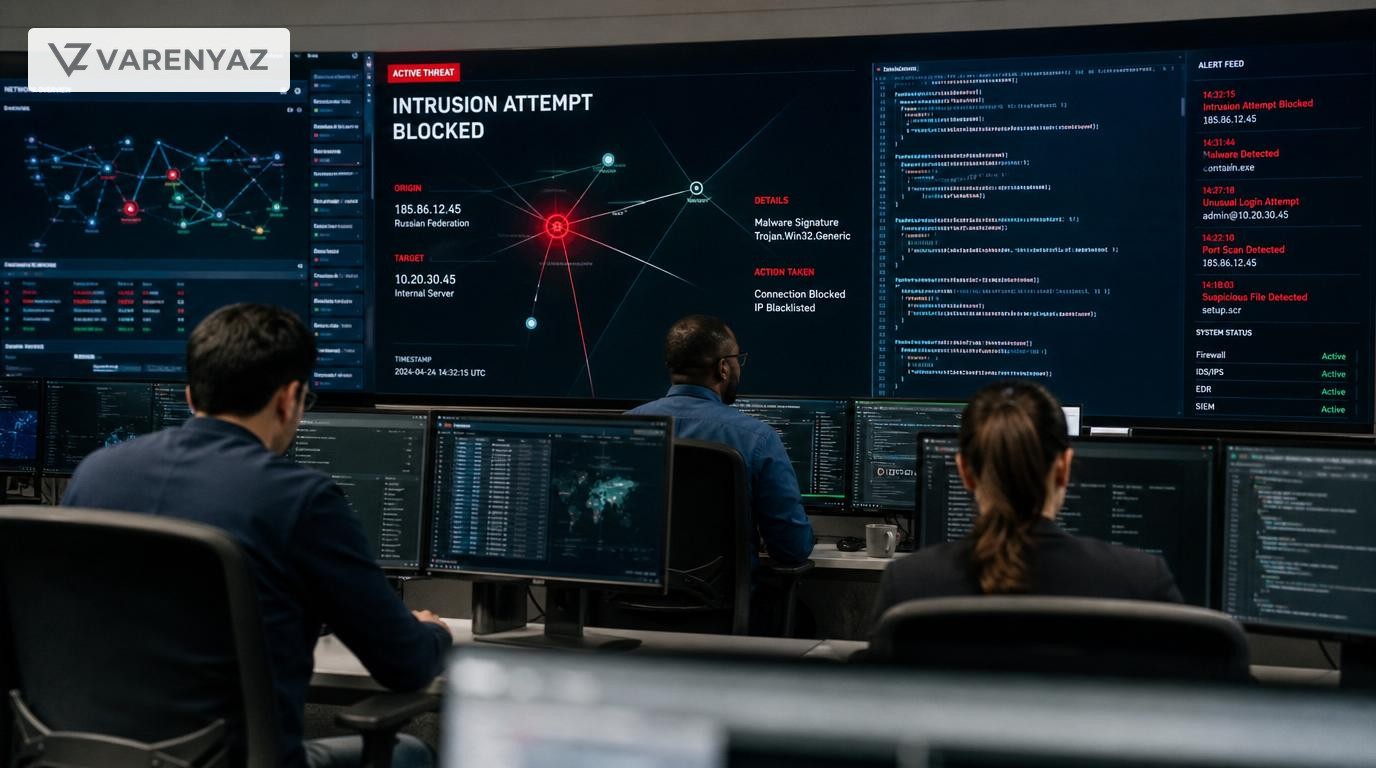
What Happened In Brief
Exaforce has raised a $125 million Series B round, valuing the three-year-old cybersecurity startup at $725 million. The company is building real-time AI systems that detect and stop cyberattacks as they occur, targeting enterprises that face AI-accelerated threats. For technology and security leaders, this funding signals accelerating market demand for autonomous, AI-driven security operations and will likely influence SOC modernization roadmaps, vendor evaluations, and AI infrastructure planning over the next 12–24 months.
News Desk
LiveEditorial Review
VarenyaZ Editorial Desk, Managing Editor
Global
In This Story
Coverage Signals
Key Takeaways
- Exaforce raised a $125 million Series B round, valuing the company at $725 million.
- The startup is building AI systems designed to detect and stop cyberattacks in real time.
- AI-accelerated threats are pushing enterprises to move beyond traditional signature-based security tools.
- Real-time AI defense could significantly reshape SOC workflows, automating triage, correlation, and response.
- Leaders must plan for data, integration, and skills gaps when adopting autonomous security tooling.
- This raise signals investor confidence in AI-native cybersecurity platforms as a long-term category.
- Critical infrastructure, SaaS providers, and financial services are likely early adopters of Exaforce-style platforms.
- VarenyaZ can help enterprises design secure, AI-ready architectures and automation around such security investments.
Exaforce lands $125M to push real-time AI cybersecurity into the mainstream
Cyberattacks are getting faster because attackers are using AI to scan for vulnerabilities, generate exploits, and pivot across networks in seconds. Exaforce, a three-year-old cybersecurity startup, has raised a $125 million Series B round at a $725 million valuation to fight AI with AI.
The company is building real-time AI systems designed to detect and stop cyberattacks as they happen, rather than after indicators of compromise are pieced together hours or days later. The new capital will fund R&D, go-to-market expansion, and the infrastructure needed to ingest and analyze massive volumes of security telemetry from large enterprises.
What happened: a significant bet on autonomous defense
According to reporting on the round, Exaforce’s Series B brings substantial validation to an emerging category: AI-native, autonomous cyber defense platforms.
Instead of layering machine learning on top of legacy tools, Exaforce is architected around continuous behavioral analysis across networks, applications, and endpoints. The goal is to automatically:
- Detect abnormal patterns and suspicious behaviors in real time.
- Correlate signals across diverse data sources without manual rule-writing.
- Trigger automated, policy-driven responses like isolating assets or blocking connections.
For a startup still under five years old, a $725 million valuation signals strong investor conviction that enterprises are ready to adopt more autonomous security operations and that this approach can scale beyond early adopters.
Why this matters: AI has changed the tempo of cyber risk
Traditional security stacks—signature-based antivirus, rule-heavy SIEMs, and manual alert triage—were not built for adversaries who can spin up AI models to discover weaknesses at scale. Several structural shifts are colliding at once:
- Attackers are automating discovery and exploitation with AI-generated phishing, automated recon, and rapid lateral movement.
- Enterprises are shipping faster with microservices, APIs, and multi-cloud, expanding the potential attack surface.
- SOC teams are overwhelmed by alert volumes, inconsistencies across tools, and staffing constraints.
Real-time AI cybersecurity, as envisioned by Exaforce, aims to match this tempo: systems that never sleep, correlate more data than humans can process, and act automatically within defined guardrails.
For boards and executive teams, the implications are strategic: resilience now depends not just on preventing breaches, but on how quickly threats are detected, contained, and learned from.
How Exaforce’s approach could reshape SOC operations
Many CISOs are already experimenting with AI inside their SOCs, from anomaly detection to intelligent alert routing. Exaforce’s pitch is more ambitious: turn AI into the central nervous system of detection and response, not just an add-on analytics layer.
If Exaforce—and similar platforms—deliver on their promises, security operations could shift in several ways:
- From rules to behaviors: Less reliance on static signatures and manual correlation, more focus on behavioral baselines and real-time deviations.
- From ticket queues to playbooks: High-confidence incidents trigger automated workflows that isolate users, containers, or services without waiting for human approval in low-risk scenarios.
- From reactive to proactive: Continuous learning loops, where each attempted attack feeds models that harden the environment ahead of similar campaigns.
For resource-constrained teams in growth-stage companies, this could mean meaningful coverage gains without a linear increase in headcount.
Business impact: decisions for CTOs, CISOs, and product leaders
For leadership teams in India, the United States, the United Kingdom, and beyond, Exaforce’s raise is less about one vendor and more about a directional trend: security stacks are being rebuilt around AI.
Key decisions now taking shape in boardrooms and architecture reviews include:
- Build vs. buy AI defense: Whether to rely on specialist vendors, hyperscaler-native tools, or in-house ML for detection and response.
- Data strategy: How to centralize and label security telemetry from applications, infrastructure, endpoints, and identity systems so AI can reason over it effectively.
- Risk appetite for autonomy: Where to enable fully automated responses (for example, blocking known-malicious IOC patterns) and where to keep humans in the loop.
- Impact on product and engineering: How to embed security telemetry, hooks, and controls directly into applications and APIs so AI-driven defense has the signals it needs.
For SaaS platforms, fintechs, healthtech, and critical infrastructure providers, these decisions translate directly into customer trust, regulatory posture, and platform uptime.
AI, search, and software relevance
The same AI capabilities that power Exaforce-style platforms are flowing into other parts of the stack:
- Application-level defenses: Instrumenting APIs and microservices with event streams that detection models can consume in near real time.
- AI-powered search and observability: Using LLMs and vector search to query logs, traces, and security events conversationally across massive datasets.
- Software supply chain security: Applying ML to code repositories, dependency graphs, and CI/CD telemetry to spot anomalous changes before they reach production.
As digital products become more AI-infused themselves, security architecture must treat data, models, and prompts as first-class assets. Real-time, AI-aware defense is quickly becoming table stakes for modern software organizations.
Risks and open questions around autonomous security
Despite the momentum behind Exaforce and its peers, leaders should approach autonomous defense with a clear-eyed view of risks and unknowns:
- Model opacity and explainability: Security teams need to understand why an AI system blocked a connection or isolated a host, especially in regulated sectors.
- False positives and operational impact: Overly aggressive automation can disrupt business-critical services and erode trust in the platform.
- Adaptation by attackers: Adversaries will probe how AI-driven defenses behave, then design campaigns that exploit blind spots or poison training data.
- Integration complexity: Plugging AI defense into heterogeneous, legacy-heavy environments—OT systems, on-prem workloads, older ERPs—remains challenging.
Strong governance, staged rollouts, and clear escalation paths will be crucial as enterprises move from pilot projects to production deployments of autonomous security tooling.
What happens next: signals to watch
Exaforce’s funding round is likely the beginning, not the peak, of investment into AI-native cyber defense. Over the next 12–24 months, leaders should monitor:
- Customer logos and case studies: Which industries and company sizes successfully deploy real-time AI defense platforms in production.
- Partnerships with cloud and security majors: How platforms like Exaforce integrate with hyperscalers, SIEMs, and EDR suites.
- Regulatory viewpoints: Emerging guidance from regulators on automated security decisions, data residency for telemetry, and model accountability.
- Talent trends: Rising demand for hybrid skillsets that combine security engineering, ML, and data engineering.
For investors, the number and scale of follow-on rounds in adjacent startups will be a proxy for the durability of this category.
Implications for your digital products and platforms
For founders, CTOs, and product leaders, Exaforce’s raise is a reminder that security architecture can no longer be an afterthought to feature roadmaps. Whether or not you adopt Exaforce specifically, you will increasingly be expected to:
- Design applications for observability by default, exposing high-quality signals to security tools.
- Automate incident response workflows across ticketing, messaging, and infrastructure controls.
- Treat security and AI architecture as intertwined, not separate disciplines.
If your organization is evaluating how to modernize its web platforms, internal tools, and AI capabilities with security in mind, you can start a tailored conversation with the VarenyaZ team at https://varenyaz.com/contact/.
How VarenyaZ can help you prepare for AI-driven security
VarenyaZ works with startups, scale-ups, and enterprises to build secure, AI-ready digital systems—from customer-facing web experiences to custom internal platforms.
In the context of real-time AI cybersecurity and platforms like Exaforce, our teams can help you:
- Architect secure web and app platforms with the right telemetry, identity, and policy layers to support AI-driven defense.
- Integrate security tooling into CI/CD, observability, and incident response processes, reducing the friction between engineering and security teams.
- Automate workflows that connect detection systems with infrastructure controls, collaboration tools, and runbooks.
- Prototype and deploy AI features in your products with secure data handling, guardrails, and governance baked in.
As attackers weaponize AI, the organizations that win will be those that pair strong product execution with equally strong, AI-aware security design. Exaforce’s funding is one more data point that the security stack is being rewritten. VarenyaZ can help you ensure your web platforms, applications, and AI initiatives are ready for that future—secure, resilient, and built for continuous adaptation.
Editorial Perspective
"Exaforce’s funding round is a clear signal that the center of gravity in cybersecurity is shifting from post-incident analysis toward real-time, AI-driven decisioning at the edge of the network."
"For fast-growing digital businesses, the practical question is no longer whether to use AI in security, but how to design architectures, data pipelines, and governance models that can safely support autonomous defense."
Frequently Asked Questions
What is Exaforce building with its $125M Series B funding?
Exaforce is developing AI-powered systems that can detect and stop cyberattacks in real time. Instead of relying solely on static rules or signatures, its platform aims to continuously analyze behavior across networks, applications, and endpoints, automatically correlating signals and triggering rapid, policy-driven responses as threats emerge.
Why does real-time AI cybersecurity matter for enterprises now?
Attackers are increasingly using AI to discover vulnerabilities, automate phishing, and pivot across networks faster than human analysts can respond. Real-time AI cybersecurity promises to close that gap by monitoring activity continuously, learning from patterns, and initiating containment steps within seconds, which is critical for cloud-native and always-on digital businesses.
How could Exaforce’s approach change SOC operations?
Exaforce’s real-time AI could automate key SOC tasks such as alert correlation, incident prioritization, and first-line containment. This could reduce alert fatigue, allow analysts to focus on complex investigations and threat hunting, and support lean security teams that need to protect large, distributed environments with limited headcount.
What should CTOs and CISOs assess before adopting AI-driven cyber defense?
Technology leaders should evaluate data quality and coverage, integration with existing SIEM and EDR tools, latency requirements, explainability of AI decisions, compliance constraints, and the ability to override or tune automated responses. They should also plan for change management so security, IT, and engineering teams can work effectively with autonomous systems.
How can VarenyaZ support organizations considering tools like Exaforce?
VarenyaZ can help organizations design secure, AI-ready architectures, integrate security tools into web and custom application stacks, and automate workflows between detection, ticketing, and incident response systems. Our teams also help apply secure-by-design principles in new builds so AI-powered defense adds value instead of complexity.
Selected References
Stay Ahead
Get concise, actionable insights on AI, digital strategy, and innovation. No spam, just value.
More Coverage
Related News
Jun 26, 2026
General Intuition Bets $2.3B That Games Can Train Real-World AI
General Intuition is making a multibillion-dollar bet that video games are the best simulation layer for training real-world AI agents. After raising hundreds of millions to scale, the company uses millions of hours of gameplay as action data for reinforcement learning, aiming to build agents that generalize to logistics, robotics, and enterprise automation. For leaders, the move signals that synthetic, game-like environments are becoming strategic infrastructure for decision-making AI, with implications for product design, operations, and AI-driven software.
Jun 25, 2026
HaloBraid raises $7M to reinvent salon braiding workflows
HaloBraid has raised $7 million in funding, led by Alexis Ohanian’s Seven Seven Six, to launch a braiding-assistant device for professional salons. The hardware-plus-software tool is designed to reduce multi-hour braiding appointments into more efficient sessions, helping salons increase chair turnover, reduce stylist burnout, and expand textured-hair services. For founders and CTOs, HaloBraid highlights how specialized hardware and workflow automation can unlock value in overlooked, service-heavy verticals like beauty and personal care.
Jun 24, 2026
Menlo Ventures’ $3B AI Fund Raises the Stakes for Anthropic Bet
Menlo Ventures has raised a new $3 billion fund, heavily oriented around artificial intelligence, following the strong paper gains from its high-conviction $750 million investment in Anthropic in 2024. The raise underscores a shift toward larger, concentrated AI bets by top-tier VCs. For founders and enterprise leaders, this signals fiercer competition for AI talent and capital, a premium on defensible infrastructure and workflow products built on foundation models, and a rapid acceleration of AI-first roadmaps in software, cloud, and automation.