
Top 7 Performance Engineering Best Practices
Discover seven performance engineering best practices that help hospitality and entertainment brands deliver fast, resilient, and profitable digital experiences.

Quick Answer
This article outlines seven performance engineering best practices for hospitality and entertainment brands, focusing on business impact, guest experience, and resilience. It explains how to set performance SLOs tied to revenue, choose scalable architectures, build end-to-end observability, optimize capacity for peaks, prioritize mobile and low-bandwidth users, design for failure, and run structured experiments. Leaders get clear implementation steps, risk considerations, and how a partner like VarenyaZ can help with web, platform, and AI-driven optimization.
In this article
Coverage signals
14 min
Jun 7, 2026
VarenyaZ Editorial Desk, Technical Content Review
Updated Jun 7, 2026
Key Takeaways
- Tie performance objectives directly to bookings, ticket sales, and guest satisfaction instead of generic page-speed metrics.
- Combine caching, CDNs, and modern architectures like microservices or modular monoliths to handle large traffic spikes.
- Invest in end-to-end observability across web, apps, APIs, and third-party integrations to find bottlenecks before guests do.
- Use realistic performance and load testing that mimic peak booking windows, event onsales, and on-property Wi‑Fi constraints.
- Prioritize mobile performance, offline-tolerant flows, and low-bandwidth experiences for travelers and on-the-go guests.
- Engineer for failure using graceful degradation, timeouts, circuit breakers, and fallbacks for third-party providers.
- Continuously experiment with performance improvements and measure commercial outcomes, not just technical scores.
- A partner like VarenyaZ can help design, build, and optimize performance-first web platforms, APIs, and AI-driven experiences.
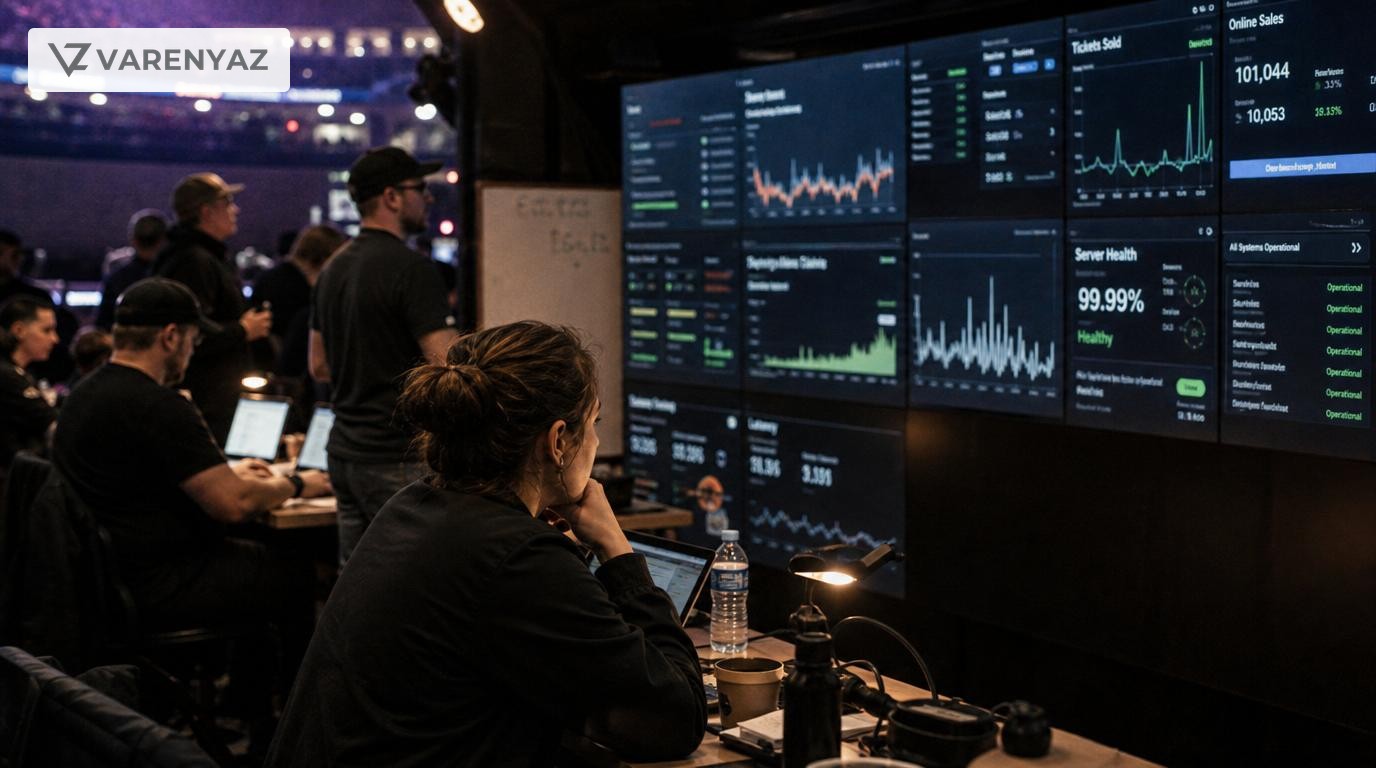
Top 7 Performance Engineering Best Practices for Hospitality & Entertainment
In hospitality and entertainment, performance is not just a technical metric—it is your digital front desk, box office, and concierge rolled into one. When a page hangs during checkout or an app stalls at check-in, guests do not see a latency spike; they see a broken promise.
This guide walks through seven practical performance engineering best practices tailored for hotels, resorts, venues, ticketing platforms, and entertainment brands. The focus: aligning technical decisions with revenue, guest satisfaction, and operational calm.
Quick Answer: What Are the Top 7 Performance Engineering Best Practices?
For hospitality and entertainment businesses, the top seven performance engineering best practices are:
- Set business-aligned performance SLOs tied to bookings, ticket sales, and guest journeys.
- Adopt a scalable, cache-aware architecture using CDNs, smart caching, and modular services.
- Build end-to-end observability across web, apps, APIs, and third parties.
- Run realistic performance and load testing that mimic actual event and booking peaks.
- Engineer for mobile and low-bandwidth users with lean payloads and offline-tolerant flows.
- Design for failure and graceful degradation so dependencies can fail without breaking the journey.
- Continuously experiment and optimize to connect technical improvements with commercial outcomes.
Let’s unpack what each of these looks like in a real hospitality or entertainment environment.
1. Tie Performance Engineering to Real Revenue Moments
Most teams still talk about performance in vague terms: “The site feels slow” or “We need better uptime.” In hospitality and entertainment, that is not enough. You need performance objectives that mirror your actual revenue and guest experience moments.
Define business-aligned SLOs
Service Level Objectives (SLOs) give performance engineering a measurable target. Instead of “fast page loads,” define:
- Booking SLO: 95% of booking journeys (search > select > pay > confirm) complete in under X seconds.
- Ticketing SLO: 99% of ticket purchase requests respond in under 500 ms during onsale peaks.
- Check-in SLO: 99% of mobile check-in API calls succeed within 1 second.
- Guest app SLO: 95% of page transitions in the app meet Core Web Vitals guidelines for perceived speed.
The key is to focus on end-to-end journeys, not just single API calls or pages.
Map performance to guest journeys and revenue
Start by mapping your high-value flows:
- New booking or reservation journeys.
- Ticket purchase and seat selection for events.
- Mobile check-in, digital keys, or queueing systems.
- On-property ordering (room service, F&B, spa, in-venue concessions).
For each journey, track:
- Time-to-first-interaction (when guests feel the system responded).
- Drop-off points (where slow performance correlates with abandonment).
- Revenue per minute or bookings per minute during peaks.
Research and industry practice show that user-centric metrics like Core Web Vitals strongly correlate with engagement and conversion, which is why they are a useful foundation for your SLOs.
Align teams around shared performance outcomes
Performance engineering only works if product, engineering, operations, and marketing share the same scoreboard. Make performance metrics visible in:
- Weekly business reviews (bookings vs. response times).
- Campaign planning (expected traffic and capacity).
- Post-event retrospectives (how the system behaved at peak).
This shifts performance from being an “engineering concern” to a business lever.
2. Architect for Scalability, Caching, and Spiky Demand
Hospitality and entertainment do not see smooth, predictable traffic curves. They see spikes:
- Concert onsales where thousands of fans all hit “Buy” at once.
- Black Friday or New Year booking surges.
- Peak check-in hours across multiple properties.
Your architecture must be designed for these spikes, not average traffic.
Use CDNs and smart caching aggressively
A well-configured Content Delivery Network (CDN) is often the single most cost-effective performance upgrade. For hospitality and entertainment platforms, CDNs can:
- Serve static assets (images, scripts, styles) close to guests in different regions.
- Cache semi-static content like event details, property descriptions, and menus.
- Offload a large share of traffic from your origin servers during surges.
Best practices include:
- Define clear caching rules for static vs. dynamic content.
- Use cache keys and variations carefully (e.g., per locale or property).
- Configure fast cache invalidation for time-sensitive changes like pricing.
Choose a scalable application architecture
There is no one-size-fits-all, but high-performing hospitality and entertainment platforms typically use one of these patterns:
- Well-structured modular monolith with clear boundaries and horizontal scaling for simpler estates.
- Microservices for larger operators, separating search, pricing, reservations, inventory, and payments.
- API-first back ends that support web, mobile apps, kiosks, and partner channels consistently.
Whichever you choose, focus on:
- Stateless services that can be scaled out easily.
- Async processing for non-critical tasks (emails, analytics, notifications).
- Database sharding or read replicas for high-read workloads like availability lookup.
Manage third-party dependencies carefully
Payment gateways, ticketing providers, loyalty systems, and channel managers can all become bottlenecks. Architect with:
- Connection pooling and timeouts for external APIs.
- Fallback caches for availability or pricing snapshots.
- Bulkheads to prevent one slow dependency from exhausting resources.
These patterns reduce the risk of a partner’s latency becoming your system-wide outage.
3. Build End-to-End Observability Across Channels
You cannot engineer performance if you cannot observe it. In hospitality and entertainment, guests may move between website, mobile app, kiosk, call center, and on-property devices in a single journey. You need visibility across that entire path.
Combine logging, metrics, and traces
Modern observability typically includes:
- Centralized logs for application, server, and network events.
- Metrics (latency, error rates, CPU, memory, queue lengths) stored in time-series databases.
- Distributed traces that follow a request across services and dependencies.
Structured logging and correlation IDs let you see how a single guest’s booking request moved from edge to database and where it slowed down.
Monitor user-centric performance, not just infrastructure
Infrastructure health is necessary but not sufficient. For guest experience you also need:
- Real User Monitoring (RUM) to capture actual load times, Core Web Vitals, and errors in the wild.
- Synthetic monitoring to run scripted journeys (search, book, pay) every few minutes from key regions.
- Mobile performance analytics for app start-up time, screen transitions, and crashes.
This data highlights issues specific to certain device types, networks, or countries that averages hide.
Connect observability to alerting and incident response
Observability becomes performance engineering when it triggers action:
- Define alerts for guest-impacting symptoms (e.g., spike in failed check-ins, payment errors, or search timeouts), not just CPU.
- Route alerts to on-call teams with clear, tested runbooks.
- Tag data by property, event, region, and channel so you can localize issues quickly (e.g., only affecting a city or a payment method).
Over time, your incident post-mortems should feed into architectural changes and capacity planning.
4. Test for Real-World Peaks, Not Lab Conditions
Hospitality and entertainment systems usually work fine at 2 a.m. on a Tuesday. The question is: how do they behave when everybody arrives at once?
Mirror real traffic patterns in performance tests
Design performance tests around real scenarios like:
- High-traffic onsale for a major event at 10 a.m. local time.
- Weekend booking waves for holiday periods.
- Simultaneous check-in and on-property ordering spikes.
For each scenario, run:
- Load tests to validate your expected traffic capacity.
- Stress tests to find the breaking point where latency and errors soar.
- Spike tests to emulate sudden surges, like everyone clicking a link at once.
Use tools or cloud services that support distributed load generation from different regions to mimic real guest distribution.
Test end-to-end journeys, not isolated APIs
Isolated API times can be deceptive. Your guests experience:
- Search > availability > selection > add-ons > payment > confirmation.
- Seat map > upgrade options > payment > ticket delivery.
Build test scripts that execute these workflows and measure total time and failure rates. Pay attention to:
- 95th/99th percentile latencies, not just averages.
- Errors under load (timeouts, rate limits, gateway errors).
- Impact of third-party APIs when they slow or throttle.
Rehearse failure and rollback
Performance engineering is also about knowing how to respond when things go wrong:
- Practice blue-green or canary releases for new features.
- Simulate partial outages like a payment provider failure.
- Verify that feature flags, rollbacks, and fallbacks work under pressure.
These rehearsals turn high-stakes events into controlled operations rather than panic-driven firefights.
5. Engineer for Mobile, Low Bandwidth, and On-the-Go Guests
Many guests are not on fiber at a desk. They are:
- Booking from airport Wi‑Fi.
- Checking in from a rural resort with patchy connectivity.
- Buying tickets on the move outside a venue.
That makes mobile-first performance a critical part of performance engineering.
Prioritize front-end and API efficiency
To support mobile and constrained networks:
- Optimize images with modern formats and responsive sizes.
- Minimize JavaScript and CSS; remove unused bundles.
- Use lazy loading for non-critical content and assets.
- Simplify initial payloads for faster first interaction.
On the back end, expose lean APIs that return just what the client needs, avoiding over-fetching data.
Design offline-tolerant and low-connectivity flows
For on-property and event experiences, assume flaky connectivity:
- Cache recent reservations or tickets on the device.
- Queue actions (e.g., orders) for retry when network is back.
- Show clear state to guests (e.g., “Reconnecting” vs. silent failures).
This is especially important for digital keys, queueing, and seat upgrades where guests are already at your venue or property.
Continuously track Core Web Vitals
Metrics such as Largest Contentful Paint (LCP), Interaction to Next Paint (INP), and Cumulative Layout Shift (CLS) are useful because they are aligned with real user experience. They help you understand:
- How quickly guests see meaningful content.
- How responsive your interface feels to taps and clicks.
- Whether your layout jumps and causes mis-taps on mobile.
Monitoring these across your booking and ticketing journeys ensures your design decisions do not accidentally slow experiences down.
6. Design for Failure, Not Just for the Happy Path
Performance engineering in hospitality and entertainment is as much about resilience as raw speed. There will be network issues, dependency outages, and sudden demand spikes. The question is: what happens to the guest?
Implement timeouts, retries, and circuit breakers
Slow dependencies are often worse than failing fast. Use patterns such as:
- Timeouts so no single call can hang indefinitely.
- Retries with backoff for transient failures, but avoid overloading services.
- Circuit breakers to temporarily stop calling an unhealthy service.
Configure these carefully to reflect the importance of each action. For example, retrieving loyalty points might fail more gracefully than confirming a payment.
Design graceful degradation for critical journeys
When systems are under pressure, it is better to degrade gracefully than to fail entirely. Examples include:
- Allowing simplified search when full availability lookup is slow.
- Temporarily hiding low-priority upsells to reduce load.
- Switching to cached pricing snapshots with clear messaging.
For event ticketing, consider virtual waiting rooms, pre-queueing, and controlled release of seats to keep systems stable during onsales.
Plan for geo and multi-property resilience
For groups operating across multiple cities or countries:
- Use multi-region deployments or at least cross-zone redundancy for critical services.
- Ensure failover strategies are tested and automated where possible.
- Segment systems to limit the blast radius of an outage to a specific property or region.
This approach keeps local incidents from cascading into a global brand problem.
7. Continuously Experiment, Optimize, and Use AI Wisely
Performance engineering is not a one-time project; it is an ongoing discipline. The most advanced hospitality and entertainment teams iterate, measure, and adjust continuously.
Run structured experiments on performance improvements
When you roll out a performance change, treat it as an experiment:
- Define a hypothesis (e.g., “Reducing search API latency by 200 ms will increase conversions by 2%”).
- Deploy changes gradually (e.g., canary releases or A/B tests).
- Measure impact on both technical metrics and business KPIs (conversion, average order value, abandonment).
This approach prevents over-optimizing for metrics that do not move revenue or guest satisfaction.
Use AI and analytics for smarter performance engineering
Large data volumes from logs, traces, and metrics are hard to interpret manually. AI and advanced analytics can assist by:
- Detecting anomalies in latency or error patterns faster than manual dashboards.
- Predicting demand peaks based on seasonality, event schedules, and marketing campaigns.
- Highlighting specific segments (e.g., region, device type) where performance degrades.
When combined with autoscaling and capacity planning, this helps you scale infrastructure before problems appear, not after social media complaints.
Integrate performance into your development lifecycle
Performance engineering should be part of how you build, not just how you fix:
- Add performance budgets to design and development workflows.
- Run automated performance checks in CI/CD pipelines for critical flows.
- Make performance feedback available to product managers and designers, not just engineers.
Over time, this culture shift produces products that are “fast by default” instead of relying on after-the-fact optimization.
Implementation Roadmap: From Firefighting to Performance Engineering
If your current reality is reactive firefighting during every big event or season, you can still move toward a structured performance engineering practice in phases.
Phase 1: Stabilize the essentials (0–3 months)
- Identify your top 3–5 guest journeys (booking, ticketing, check-in).
- Measure current performance and error rates end to end.
- Implement quick wins: CDN configuration, caching, image optimization.
- Set basic SLOs and alarms for severe failures and latency spikes.
Phase 2: Build observability and resilience (3–9 months)
- Roll out RUM, synthetic monitoring, and distributed tracing.
- Introduce timeouts, retries, and circuit breakers for key dependencies.
- Run targeted load and stress tests before major events or seasons.
- Document and rehearse incident response for your highest-risk journeys.
Phase 3: Optimize and modernize (9–18 months)
- Refine architecture (e.g., modularization, microservices where needed).
- Automate performance regression checks in your CI/CD pipeline.
- Use AI-assisted analytics for predictive capacity planning and anomaly detection.
- Continuously test new performance improvements and measure business impact.
A capable technology partner can shorten each of these phases by bringing templates, tooling, and cross-industry experience.
How VarenyaZ Helps Hospitality & Entertainment Brands Engineer Performance
For hospitality and entertainment leaders, the challenge is rarely knowing that performance matters; it is turning that awareness into a reliable, scalable digital estate without derailing day-to-day operations.
VarenyaZ works with founders, CTOs, product leaders, and operations teams to design and build performance-first web platforms, APIs, and AI-powered experiences that fit the realities of hotels, venues, and entertainment brands.
Performance-focused web and product engineering
Our web design and development teams build booking and ticketing experiences that prioritize:
- Clean, intuitive UX optimized for mobile and low-bandwidth users.
- Fast, cache-aware front ends aligned with Core Web Vitals.
- Robust back ends and APIs designed for traffic spikes and multi-channel delivery.
AI-driven observability and optimization
We help you move beyond ad hoc monitoring to AI-assisted performance engineering by:
- Implementing logging, metrics, and tracing tailored to guest journeys.
- Using AI to detect anomalies, predict demand peaks, and surface root causes faster.
- Connecting technical metrics with commercial KPIs like conversion and revenue per session.
Modernization without disrupting operations
Many hospitality and entertainment brands live with a mix of legacy PMS, POS, and ticketing systems. VarenyaZ helps you modernize step by step:
- Introducing API layers and modular services around existing systems.
- Refactoring high-impact components without forcing big-bang rewrites.
- Embedding performance testing and SLOs into your deployment pipeline.
Conclusion: Performance as a Strategic Advantage
For hospitality and entertainment businesses, performance engineering is not just about reducing load times. It is about protecting high-intent revenue moments, keeping on-property experiences smooth, and giving your teams the confidence to launch campaigns and events without fear of crash headlines.
By defining business-aligned SLOs, architecting for spikes, building observability, testing realistically, prioritizing mobile, designing for failure, and continuously optimizing with AI and analytics, you can turn performance into a strategic advantage rather than a recurring incident.
If you are ready to rethink how your booking, ticketing, or guest experience platforms perform at the moments that matter most, talk to VarenyaZ about performance-first web design, web development, and AI development tailored for hospitality and entertainment: https://varenyaz.com/contact/
Editorial Perspective
Expert Review Notes
"In hospitality and entertainment, performance engineering is less about chasing perfect scores and more about ensuring your booking, ticketing, and check-in flows never slow down when demand peaks."
"The brands winning guest loyalty treat performance as a product feature—designed, tested, and improved continuously, just like UX or pricing."
"Without observability and realistic load tests, high-traffic events quickly turn into expensive live experiments. Performance engineering flips that equation in your favor."
Frequently Asked Questions
Why is performance engineering critical for hospitality and entertainment?
Performance engineering is critical because revenue in hospitality and entertainment clusters around specific peak moments—concert onsales, seasonal bookings, last-minute reservations, and check-in windows. If your booking engine or ticketing platform slows down or fails at those moments, you lose high-intent customers, damage brand trust, and create operational chaos. Systematic performance engineering ensures your platforms are ready for peaks, consistent across regions and devices, and resilient to dependency failures.
How do we measure performance beyond simple page load time?
Move beyond basic page load time by tracking user-centric metrics such as Core Web Vitals (Largest Contentful Paint, Cumulative Layout Shift, Interaction to Next Paint), API response times, error rates, and business KPIs like conversion rate, abandonment rate, and bookings per minute during peaks. Combine synthetic monitoring with real-user monitoring and logs to understand how performance impacts guest behavior across channels.
What types of performance tests are most useful for hotels and venues?
Useful test types include baseline load tests to validate your current capacity, stress tests to find breaking points, and spike tests that simulate sudden surges like ticket onsales or flash sales. You should also run end-to-end journey tests that simulate real workflows like searching, selecting, paying, and confirming. For multi-property or multi-venue businesses, geo-distributed tests from key markets help uncover latency and CDN gaps.
How can we make our ticketing or booking platform more resilient?
Increase resilience by using redundant infrastructure across availability zones, setting timeouts and circuit breakers for external payment or inventory APIs, and introducing graceful degradation such as limited search, waitlists, or cached availability when systems are under strain. Ensure you monitor dependencies, have automated runbooks for incident response, and regularly rehearse failure scenarios like payment gateway outages or CDN misconfigurations.
Where should we start if we have legacy systems and limited resources?
Start with the highest-impact user journeys: booking, ticket purchase, check-in, or membership login. Measure their current performance, identify the slowest steps, and implement low-risk improvements such as better caching, optimized queries, image compression, and CDN configuration. In parallel, define business-aligned performance SLOs and set up basic observability for these journeys. Then plan a phased modernization, possibly with a partner like VarenyaZ, to refactor legacy components over time.
How can AI help with performance engineering in hospitality and entertainment?
AI can help by analyzing large volumes of telemetry to detect anomalies earlier, predicting traffic peaks based on seasonality and events, and highlighting performance regressions tied to specific regions, devices, or features. It can also support intelligent autoscaling policies and personalize experiences dynamically without overloading back-end systems, when combined with efficient caching and edge processing strategies.
Selected References
Further Reading
Related perspectives
Personalizing Fintech Journeys with Generative AI
Finance and fintech businesses can use generative AI personalization to transform static, generic experiences into dynamic journeys that react to each user’s context, goals, and risk profile. By combining customer data, behavioral signals, and compliant AI models, firms can generate tailored product recommendations, explanations, nudges, and support while preserving trust and regulatory alignment. Success requires a clear data strategy, human-in-the-loop governance, transparent UX, and rigorous testing. This article outlines key use cases, architecture, guardrails, and an implementation roadmap for decision-makers.
Boost Engagement with Real-Time Finance Dashboards
Real-time data dashboards help finance and fintech businesses boost customer engagement by giving users live visibility into balances, spending, investments, and risk in a clear, interactive interface. This article covers engagement-focused use cases, UX patterns, data and architecture choices, and governance requirements. It also outlines a phased roadmap—from discovery and MVP design to AI-powered personalization—plus key risks, tradeoffs, and how to align dashboards with revenue, retention, and trust goals.
Generative AI Content Creation for Healthcare
Generative AI content creation for healthcare combines large language models with clinical governance to produce accurate, patient-friendly content at scale. Done well, it supports patient education, operations, and marketing while respecting privacy and regulations like HIPAA and GDPR. Effective programs use human-in-the-loop review, guardrails, retrieval-augmented generation from vetted sources, and clear policies on PHI. This guide outlines business value, implementation patterns, risk controls, and practical steps for hospitals, healthtechs, and healthcare marketers to launch safe, production-ready AI content pipelines.